CNN核心概念与PyTorch实践:卷积、池化与LeNet详解
本文深入讲解卷积神经网络(CNN)的核心概念,包括互相关运算、卷积层、填充、步幅、多通道操作及汇聚层。通过PyTorch代码实现并演示LeNet网络结构,帮助读者理解CNN工作原理。
- 深度学习
- 人工智能
互相关运算
from symtable import Class
import torch
from torch import nn
from d2l import torch as d2l
# 实现互相关运算,X代表输入,K代表卷积核
def corr2d(X,K):
h,w = K.shape
Y = torch.zeros((X.shape[0]-h+1,X.shape[1]-w+1))
for i in range(Y.shape[0]):
for j in range(Y.shape[1]):
Y[i,j] = (X[i:i+h,j:j+w]*K).sum()
return YX = torch.tensor([[0,1,2],[3,4,5],[6,7,8]])
K = torch.tensor([[0,1],[2,3]])
corr2d(X,K)输出结果:
tensor([[19., 25.],
        [37., 43.]])
卷积层
# 实现卷积层(二维)
class Conv2D(nn.Module):
    def __init__(self,kernel_size):
        super().__init__()
        # 设置权重和偏置
        self.weight = nn.Parameter(torch.randn(kernel_size))
        self.bias = nn.Parameter(torch.zeros(1))

    def forward(self,x):
        # 前向传播
        return corr2d(x,self.weight) + self.bias
X = torch.ones(6,8)
X[:,2:6] = 0
Xtensor([[1., 1., 0., 0., 0., 0., 1., 1.],
[1., 1., 0., 0., 0., 0., 1., 1.],
[1., 1., 0., 0., 0., 0., 1., 1.],
[1., 1., 0., 0., 0., 0., 1., 1.],
[1., 1., 0., 0., 0., 0., 1., 1.],
[1., 1., 0., 0., 0., 0., 1., 1.]])K = torch.tensor([[1,-1]])Y = corr2d(X,K)
Ytensor([[ 0., 1., 0., 0., 0., -1., 0.],
[ 0., 1., 0., 0., 0., -1., 0.],
[ 0., 1., 0., 0., 0., -1., 0.],
[ 0., 1., 0., 0., 0., -1., 0.],
[ 0., 1., 0., 0., 0., -1., 0.],
[ 0., 1., 0., 0., 0., -1., 0.]])# 批次为1 ,通道为1 ,卷积核大小为(1,2)
conv2d = nn.Conv2d(1,1,(1,2),bias=False)
X = X.reshape((1,1,6,8))
Y = Y.reshape((1,1,6,7))
lr = 3e-2
for i in range(10):
Y_hat = conv2d(X)
# 计算均方误差
l = (Y_hat-Y)**2
conv2d.zero_grad()
l.sum().backward()
conv2d.weight.data[:] -= lr*conv2d.weight.grad
if( i + 1) % 2 == 0:
print(f'epoch {i+1}, loss {float(l.sum()):f}')填充与步幅
import torch
from torch import nn
def comp_conv2d(conv2d,X):
    # (1,1)表示批量大小和通道数都是1
    X = X.reshape((1,1) + X.shape)
    Y = conv2d(X)
    return Y.reshape(Y.shape[2:])
conv2d = nn.Conv2d(1,1,kernel_size=3,padding=1)
X = torch.rand(size=(8,8))
comp_conv2d(conv2d,X).shape
conv2d = nn.Conv2d(1,1,kernel_size=(3,5),padding=(0,1),stride=(3,4))
comp_conv2d(conv2d,X).shape

# 计算公式
# $(n_h - k_h + p_h + s_h) / s_h , (n_w - k_w + p_w +s_w) / s_w $(步幅默认情况为1)
多输入输出通道
# 多输入输出
from d2l import torch as d2l

X = torch.tensor([[[0,1,2],[3,4,5],[6,7,8]],[[1,2,3],[4,5,6],[7,8,9]]])
K = torch.tensor([[[0,1],[2,3]],[[1,2],[3,4]]],dtype=torch.float32)
def corr2d_multi_in(X,K):
    return sum(d2l.corr2d(x,k) for x,k in zip(X,K))

def corr2d_multi_in_out(X,K):
    return torch.stack([corr2d_multi_in(X,k) for k in K],0)
K = torch.stack((K,K+1,K+2),0)
K.shapetorch.Size([3, 2, 2, 2])corr2d_multi_in_out(X,K)输出结果
tensor([[[ 56.,  72.],
         [104., 120.]],

        [[ 76., 100.],
         [148., 172.]],

        [[ 96., 128.],
         [192., 224.]]])
汇聚层
import torch
from torch import nn
from d2l import torch as d2l

def pool2d(X,pool_size,mode='avg'):
    p_h,p_w = pool_size
    Y = torch.zeros((X.shape[0]-p_h+1,X.shape[1]-p_w+1))
    for i in range(Y.shape[0]):
        for j in range(Y.shape[1]):
            if mode == 'avg':
                Y[i,j] = X[i:i+p_h,j:j+p_w].mean()
            elif mode == 'max':
                Y[i,j] = X[i:i+p_h,j:j+p_w].max()
    return Y
构建输入张量,验证二维最大汇聚层输出
X = torch.tensor([[0,1,2],[3,4,5],[6,7,8]],dtype=torch.float32)
pool2d(X,(2,2),'max')
填充与步幅
X = torch.arange(16,dtype=torch.float32).reshape((1,1,4,4))
X
# 设置kernel_size为3
pool2d = nn.MaxPool2d(kernel_size=3)
pool2d(X)# 设置填充和步幅
pool2d = nn.MaxPool2d(kernel_size=3,padding=1,stride=2)
pool2d(X)多通道
X = torch.cat((X,X+1),1)
X
tensor([[[[ 0., 1., 2., 3.],
[ 4., 5., 6., 7.],
[ 8., 9., 10., 11.],
[12., 13., 14., 15.]],
[[ 1., 2., 3., 4.],
[ 5., 6., 7., 8.],
[ 9., 10., 11., 12.],
[13., 14., 15., 16.]]]])pool2d = nn.MaxPool2d(kernel_size=3,padding=1,stride=2)
pool2d(X)tensor([[[[ 5., 7.],
[13., 15.]],
[[ 6., 8.],
[14., 16.]]]])卷积神经网络(LeNet)
# LeNet
import torch
from torch import nn
from d2l import torch as d2l

net = nn.Sequential(
    nn.Conv2d(1,6,kernel_size=5,padding=2),
    nn.Sigmoid(),
    nn.AvgPool2d(kernel_size=2,stride=2),
    nn.Conv2d(6,16,kernel_size=5,padding=0),
    nn.Sigmoid(),
    nn.AvgPool2d(kernel_size=2,stride=2),
    nn.Flatten(),
    nn.Linear(16*5*5,120),
    nn.Sigmoid(),
    nn.Linear(120,84),
    nn.Sigmoid(),
    nn.Linear(84,10)
)

X = torch.rand(size=(1,1,28,28),dtype=torch.float32)
for layer in net:
    X = layer(X)
    print(layer.__class__.__name__, 'output shape:\t', X.shape)
输出结果(可口算一下shape)
Conv2d output shape:	 torch.Size([1, 6, 28, 28])
Sigmoid output shape:	 torch.Size([1, 6, 28, 28])
AvgPool2d output shape:	 torch.Size([1, 6, 14, 14])
Conv2d output shape:	 torch.Size([1, 16, 10, 10])
Sigmoid output shape:	 torch.Size([1, 16, 10, 10])
AvgPool2d output shape:	 torch.Size([1, 16, 5, 5])
Flatten output shape:	 torch.Size([1, 400])
Linear output shape:	 torch.Size([1, 120])
Sigmoid output shape:	 torch.Size([1, 120])
Linear output shape:	 torch.Size([1, 84])
Sigmoid output shape:	 torch.Size([1, 84])
Linear output shape:	 torch.Size([1, 10])
batch_size = 256
train_iter,test_iter = d2l.load_data_fashion_mnist(batch_size)def evaluate_accuracy_gpu(net,data_iter,device=None):
if isinstance(net,torch.nn.Module):
net.eval()
if not device:
device = next(iter(net.parameters())).device
# 正确预测的数量和总的预测数量
metric = d2l.Accumulator(2)
with torch.no_grad():
for X,y in data_iter:
if isinstance(X,list):
X = [x.to(device) for x in X]
else:
X = X.to(device)
y = y.to(device)
metric.add(d2l.accuracy(net(X),y),y.numel())
return metric[0]/metric[1]
def train_ch6(net,train_iter,test_iter,num_epochs,lr,device):
def init_weights(m):
if type(m) == nn.Linear or type(m) == nn.Conv2d:
nn.init.xavier_uniform_(m.weight)
net.apply(init_weights)
print('training on',device)
net.to(device)
optimizer = torch.optim.SGD(net.parameters(),lr=lr)
loss = torch.nn.CrossEntropyLoss()
animator = d2l.Animator(xlabel='epoch', xlim=[1, num_epochs],
legend=['train loss', 'train acc', 'test acc'])
timer,num_batches = d2l.Timer(),len(train_iter)
for epoch in range(num_epochs):
metric = d2l.Accumulator(3)
net.train()
for i,(X,y) in enumerate(train_iter):
timer.start()
optimizer.zero_grad()
X,y = X.to(device),y.to(device)
y_hat = net(X)
l = loss(y_hat,y)
l.backward()
optimizer.step()
with torch.no_grad():
metric.add(l*X.shape[0],d2l.accuracy(y_hat,y),X.shape[0])
timer.stop()
train_l = metric[0]/metric[2]
train_acc = metric[1]/metric[2]
if (i+1) % (num_batches//5) == 0 or i == num_batches-1:
animator.add(epoch + (i+1)/num_batches,
(train_l, train_acc, None))
test_acc = evaluate_accuracy_gpu(net,test_iter)
animator.add(epoch+1, (None, None, test_acc))
print(f'loss {train_l:.3f}, train acc {train_acc:.3f}, test acc {test_acc:.3f}')
print(f'{metric[2] * num_epochs / timer.sum():.1f} examples/sec on {str(device)}')lr,num_epochs = 0.9,10
train_ch6(net,train_iter,test_iter,num_epochs,lr,d2l.try_gpu())loss 0.473, train acc 0.822, test acc 0.808
9342.8 examples/sec on cpu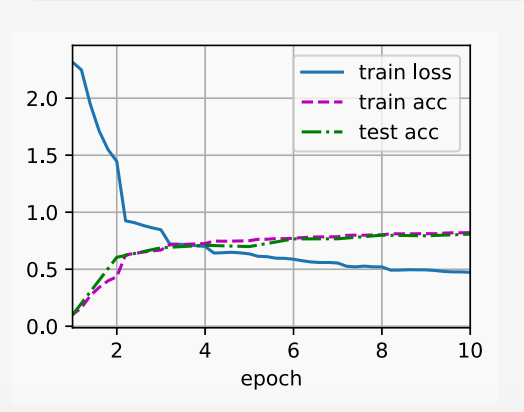
留言讨论
0 条留言
正在加载留言...