LeetCode 刷题记录:Java/C++ 算法实战
本文记录了在 LeetCode 上解决多道经典算法题的实践过程,涵盖链表、数组和字符串操作,并提供了 C++ 和 Java 两种语言的解法。旨在分享刷题经验,提升算法能力。
- 算法
- 编程实践
Medium
Topics
Companies
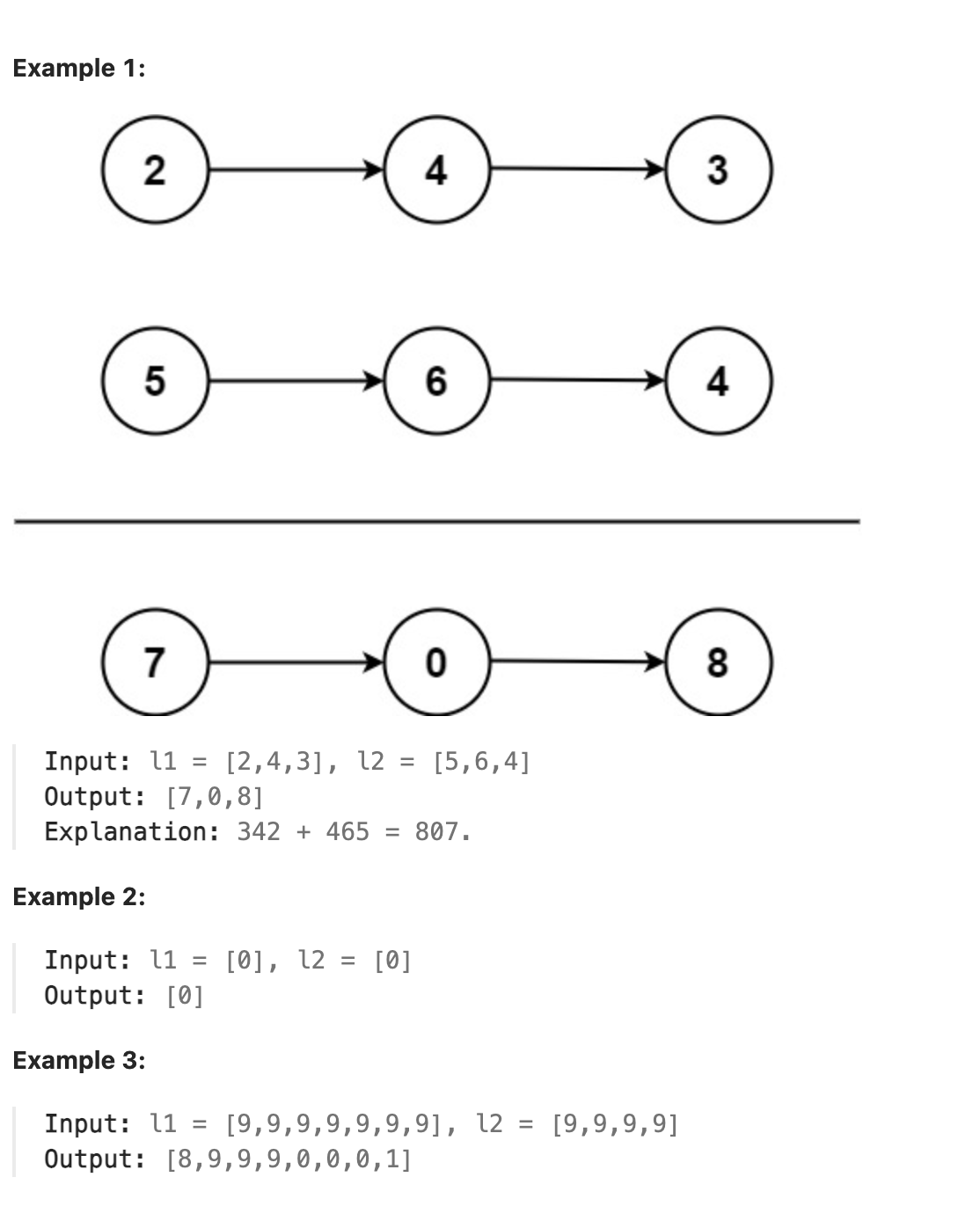
You are given two non-empty linked lists representing two non-negative integers. The digits are stored in reverse order, and each of their nodes contains a single digit. Add the two numbers and return the sum as a linked list.
You may assume the two numbers do not contain any leading zero, except the number 0 itself.
/**
 * Definition for singly-linked list.
 * struct ListNode {
 *     int val;
 *     ListNode *next;
 *     ListNode() : val(0), next(nullptr) {}
 *     ListNode(int x) : val(x), next(nullptr) {}
 *     ListNode(int x, ListNode *next) : val(x), next(next) {}
 * };
 */
class Solution {
public:
    ListNode* addTwoNumbers(ListNode* l1, ListNode* l2) {
    ListNode dummy(0); // 使用一个虚拟头节点
    ListNode* res = &dummy;
    int carry = 0;

    while (l1 != nullptr || l2 != nullptr || carry) {
        int sum = carry;
        if (l1 != nullptr) {
            sum += l1->val;
            l1 = l1->next;
        }
        if (l2 != nullptr) {
            sum += l2->val;
            l2 = l2->next;
        }

        carry = sum / 10;
        res->next = new ListNode(sum % 10);
        res = res->next;
    }

    return dummy.next;
}

};
这里设计到的语法:
ListNode dummy(0); // 初始化节点struct,初始化值为0
res->next = new ListNode(sum % 10); // 新增节点,并设置初值-
Given two sorted arrays
nums1andnums2of sizemandnrespectively, return the median of the two sorted arrays.The overall run time complexity should be
O(log (m+n)).Example 1:
Input: nums1 = [1,3], nums2 = [2]
Output: 2.00000
Explanation: merged array = [1,2,3] and median is 2.
Example 2:
Input: nums1 = [1,2], nums2 = [3,4]
Output: 2.50000
Explanation: merged array = [1,2,3,4] and median is (2 + 3) / 2 = 2.5.
import java.util.ArrayList; class Solution { public double findMedianSortedArrays(int[] nums1, int[] nums2) { int m = nums1.length; int n = nums2.length; int sum = m + n; int i = 0,j =0; ArrayList<Integer> list1 = new ArrayList<Integer>(); if (m > n) { return findMedianSortedArrays(nums2, nums1); } while (i<m && j<n) { if (nums1[i] <= nums2[j]) { list1.add(nums1[i]); i++; }else if (nums1[i] > nums2[j]) { list1.add(nums2[j]); j++; } } if (j < n){ while (j < n){ list1.add(nums2[j]); j++; } } if (i < m){ while (i < m){ list1.add(nums1[i]); i++; } } System.out.println(list1); if (sum % 2 == 0){ return (double) (list1.get(sum / 2 -1) + list1.get(sum / 2)) / 2; }else { return (double) (list1.get(sum / 2)); } } public static void main(String[] args) { Solution solution = new Solution(); System.out.println(solution.findMedianSortedArrays(new int[]{1, 3, 5}, new int[]{2, 4})); } } -
public String longestPalindrome(String s) { if (s == null || s.length() == 0) return ""; int len = s.length(); boolean[][] dp = new boolean[len][len]; int start = 0,max_length = 1; for (int i = 0; i < len; i++) { dp[i][i] = true; } for (int i = 0; i < len-1; i++) { if (s.charAt(i) == s.charAt(i+1)) { dp[i][i+1] = true; start = i; max_length = 2; } } for (int l = 3 ;l <s.length() + 1;l++) { for (int i =0 ;i<s.length() - l + 1;i++) { if (s.charAt(i) == s.charAt(i+l-1) && dp[i+1][i+l-2]) { dp[i][i+l-1] = true; start = i; max_length = l; } } } System.out.println(max_length); return s.substring(start, start + max_length); } -
The string
"PAYPALISHIRING"is written in a zigzag pattern on a given number of rows like this: (you may want to display this pattern in a fixed font for better legibility)Example 2:
Input: s = "PAYPALISHIRING", numRows = 4
Output: "PINALSIGYAHRPI"
Explanation:
P     I    N
A   L S  I G
Y A   H R
P     I
public String convert_opt(String s, int numRows) { if (numRows == 1) return s; // 如果只有一行,则直接返回原字符串 StringBuilder res = new StringBuilder(); int len = s.length(); int cycleLength = 2 * numRows - 2; // 一个周期的长度,即从上到下再从下到上的字符跨度 for (int row = 0; row < numRows; row++) { // 遍历每一行 for (int i = row; i < len; i += cycleLength) { // 添加当前行和当前索引的字符 res.append(s.charAt(i)); // 处理在中间行(除了最上面和最下面的行)需要额外添加的字符 int secondCharIndex = i + cycleLength - 2 * row; if (row != 0 && row != numRows - 1 && secondCharIndex < len) { res.append(s.charAt(secondCharIndex)); } } } return res.toString(); } -
Given a signed 32-bit integer
x, returnxwith its digits reversed. If reversingxcauses the value to go outside the signed 32-bit integer range[-231, 231 - 1], then return0.Assume the environment does not allow you to store 64-bit integers (signed or unsigned).
Example 1:
Input: x = 123
Output: 321
Example 2:
Input: x = -123
Output: -321
Example 3:
Input: x = 120
Output: 21
public int reverse(int x) { if (x == 0) return 0; String s = String.valueOf(Math.abs(x)); String reversed = new StringBuilder(s).reverse().toString(); try { long result = Long.parseLong(reversed); // 处理负数 if (x < 0) { result = -result; } // 检查是否溢出 if (result < Integer.MIN_VALUE || result > Integer.MAX_VALUE) { return 0; } return (int)result; } catch (NumberFormatException e) { // 处理可能的数字格式异常 return 0; } }
Implement the myAtoi(string s) function, which converts a string to a 32-bit signed integer.
The algorithm for myAtoi(string s) is as follows:
- Whitespace: Ignore any leading whitespace (
" "). - Signedness: Determine the sign by checking if the next character is
'-'or'+', assuming positivity if neither present. 符号:通过检查下一个字符是否为'-'或'+'来确定符号,如果两者都不存在则假设为正数。 - Conversion: Read the integer by skipping leading zeros until a non-digit character is encountered or the end of the string is reached. If no digits were read, then the result is 0. 转换:跳过前导零,读取整数,直到遇到非数字字符或字符串结尾。如果未读取到任何数字,则结果为 0。
- Rounding: If the integer is out of the 32-bit signed integer range
[-231, 231 - 1], then round the integer to remain in the range. Specifically, integers less than-231should be rounded to-231, and integers greater than231 - 1should be rounded to231 - 1.
Return the integer as the final result.
public int myAtoi(String str) {

    if(str==null|str.isEmpty()) return 0;
    str=str.trim();
    if(str.isEmpty()) return 0;
    int i = 0;
    int sign = 1;
    int result = 0;
    if (str.charAt(i)=='-') {
        sign = -1;
        i++;
    }else if (str.charAt(i)=='+') {
        i++;
    }
   while (i < str.length() && Character.isDigit(str.charAt(i))) {
       int n = str.charAt(i) - '0';
       if (result > Integer.MAX_VALUE / 10 ||
               (result == Integer.MAX_VALUE / 10 && n > Integer.MAX_VALUE % 10)) {
           // Will overflow with this digit
           return sign == 1 ? Integer.MAX_VALUE : Integer.MIN_VALUE;
       }
       result = result * 10 + n;
       i++;
   }
   return result * sign;
}Given an integer x, return true if x is a palindrome*, and* false otherwise
Example 1:
Input: x = 121
Output: true
Explanation: 121 reads as 121 from left to right and from right to left.
Example 2:
Input: x = -121
Output: false
Explanation: From left to right, it reads -121. From right to left, it becomes 121-. Therefore it is not a palindrome.
Example 3:
Input: x = 10
Output: false
Explanation: Reads 01 from right to left. Therefore it is not a palindrome.
public boolean isPalindrome(int x) {
String s = String.valueOf(x);
int len = s.length();
for (int i = 0; i < len/2; i++) {
if (s.charAt(i) != s.charAt(len-i-1)) {
return false;
}
}
return true;
}
留言讨论
0 条留言
正在加载留言...